
An Epic Advent
Preparing for the celebration of Christmas with Paradise Lost, part 1 of 3

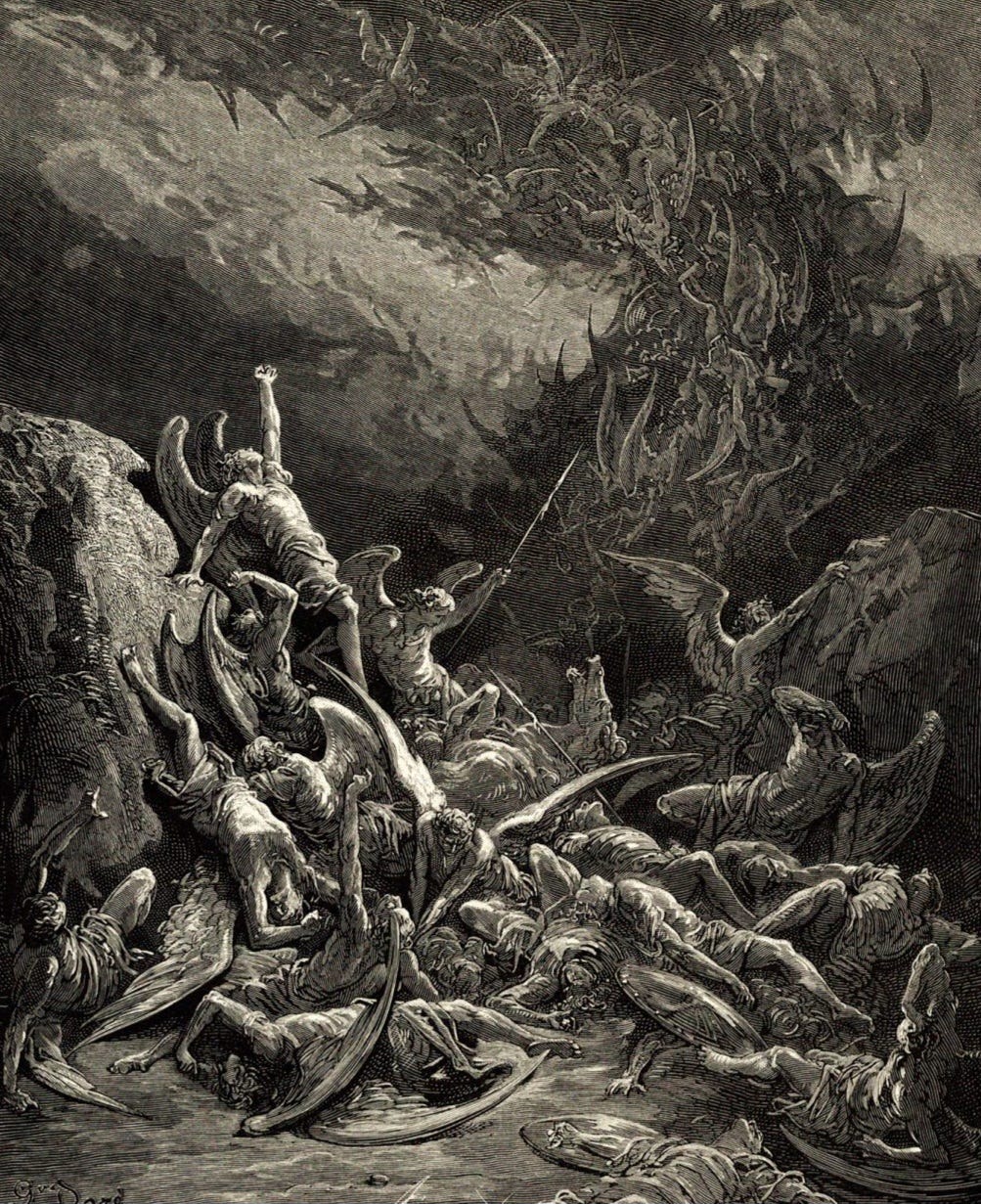
There is need of thy grace, O Lord, and of large supplies thereof, that nature may be overcome, which is ever prone to evil from her youth. For through Adam the first man, nature being fallen and corrupted by sin, the penalty of this stain hath descended upon all mankind in such sort that “nature” itself, which by thee was created good and upright, is now taken for the sin and infirmity of corrupted nature; because the inclination thereof left unto itself draweth to evil and to lower things For the small power which remaineth is, as it were, a spark lying hid in the ashes.
The Imitation of Christ, book III, chapter LV
We have been plowing our way through Paradise Lost in my British Literature class. My goal is to give them the opportunity to experience this work by helping them get their footing mentally (by which I mean I want to help them understand what they read) and poetically (by which I mean I want them to understand the images and allusions so they can participate with Milton in the experience of his poem as much as possible).
The first read in a work like this is always the most difficult because the first read is always an exploratory read; you are learning the lay of the land. Everything is new and strange, the place, the peoples, the language. I’m functioning as a guide, explaining local customs, warning them away from marshy bogs masquerading as solid land. But every read after this one will only get easier, as I’ve learned from experience and as I told my class. I want to help them see things along the way that they can appreciate. And I hope they come back someday for a reread and find that they recognize (even if vaguely) landmarks along the way.
But the fact still remains that it is a difficult book. All the students admitted as much. But how many 14 and 15 year-olds do you know who make it through the entirety of Paradise Lost at all, let alone without a struggle? How many adults? Regardless of the difficulty, they are willing to try and willing to love it. One student sent me this email after the first week’s assigned reading:
Hi Mrs. Bills, I noticed you had a lot of highlighted sections and notes in your copy of “Paradise Lost”. Are there any highlighted sections you could share with me that you personally loved throughout Books 1-4??
My response was a 12-page document with both quotes and notations. Be careful what you ask for, I guess. The notations were extra and maybe unnecessary (though the student said they were helpful), but I felt that, as a Christian, I couldn’t just plop down a poetic description of Hell as a “favorite passage” without some sort of explanation.
I planned our read of Paradise Lost to finish before our co-op breaks for Christmas because honestly, is there a better work of literature to read before our celebration of our Lord’s incarnation? I submit that there is not. Reading through it is one of the best literary companions for the Advent season because it helps us feel the darkness into which Christ was born and from which He came to save us. I highly recommend that as you make time for Handel’s Messiah and other seasonally appropriate works of art, you make time for Milton’s great epic. It is a rich poem and worth the effort to learn to love it.
To that end, I’m going to send out selections tracing the story in a three part series as a kind of Advent devotional tour through Paradise Lost. You can read it all at once or break it up and read the selections from each book throughout the week. If you were to ditch this sort-of devotional and read Paradise Lost itself, which is far far superior to this series and which you should totally do, you could read half a book each day starting on December 1st and end book 12 on Christmas Eve. Which I think is perfect timing.
A friend suggested I frame the series along a Heidelberg Catechism line of Guilt, Grace, and Gratitude. I love this idea, not because Paradise Lost neatly breaks into three such groups - it does not - but because these threads are woven throughout the work and play off each other, which means that by noticing guilt in particular, we will also notice grace more particularly, too, and gratitude will be the result. Also, I have kept the chatty, tour-guide tone that I used in the response I sent my student. I am, after all, an amateur and have no wish to come off as some kind of Milton expert. I genuinely enjoy this poem and hope this series encourages you to dive into it yourself.
Favorite passages, lines, and phrases from Paradise Lost, Books 1-4:
Part 1: Guilt
Book 1 - Hell
Lines 59-75:
…he views
The dismal situation waste and wild.
A dungeon horrible, on all sides round,
As one great furnace flamed; yet from those flames
No light; but rather darkness visible
Served only to discover sights of woe,
Regions of sorrow, doleful shades, where peace
And rest can never dwell, hope never comes
That comes to all, but torture without end
Still urges, and a fiery deluge, fed
With ever-burning sulphur unconsumed.
Such place Eternal Justice has prepared
For those rebellious; here their prison ordained
In utter darkness, and their portion set,
As far removed from God and light of Heaven
As from the centre thrice to th’ utmost pole.
Oh how unlike the place from whence they fell!
I know it might be strange to enjoy a description of hell, but Milton does such an incredible job of describing what can only be imagined – darkness visible, a fiery deluge, a place that hope can never come, like these lines 105-116, 39-142, 249-263:
What though the field be lost?
All is not lost—the unconquerable will,
And study of revenge, immortal hate,
And courage never to submit or yield:
And what is else not to be overcome?
That glory never shall his wrath or might
Extort from me. To bow and sue for grace
With suppliant knee, and deify his power
Who, from the terror of this arm, so late
Doubted his empire—that were low indeed;
That were an ignominy and shame beneath
This downfall;
... for the mind and spirit remains
Invincible, and vigour soon returns,
Though all our glory extinct, and happy state
Here swallowed up in endless misery.
…
Farewell, happy fields,
Where joy for ever dwells! Hail, horrors! hail,
Infernal world! and thou, profoundest Hell,
Receive thy new possessor—one who brings
A mind not to be changed by place or time.
The mind is its own place, and in itself
Can make a Heaven of Hell, a Hell of Heaven.
What matter where, if I be still the same,
And what I should be, all but less than he
Whom thunder hath made greater? Here at least
We shall be free; th’ Almighty hath not built
Here for his envy, will not drive us hence:
Here we may reign secure; and, in my choice,
To reign is worth ambition, though in Hell:
Better to reign in Hell than serve in Heaven.
Again, I don’t agree with Satan here at all but Milton perfectly and powerfully expresses the boasting, prideful heart.
But Milton includes little asides like this one, to help us view Satan correctly:
…the will
And high permission of all-ruling Heaven
Left him at large to his own dark designs,
That with reiterated crimes he might
Heap on himself damnation, while he sought
Evil to others, and enraged might see
How all his malice served but to bring forth
Infinite goodness, grace, and mercy, shewn
On Man by him seduced…(212-219)
I also love some of his descriptive phrases. In line 303, Milton describes the legions of fallen angels lying “Thick as autumnal leaves” which connects them with an image of something shrunken and shriveled, with death and decay; it shows their lack of strength. The fallen angels are as a pile of autumn leaves to God.
In lines 541-549 Milton describes the hellish army:
All in a moment through the gloom were seen
Ten thousand banners rise into the air,
With orient colours waving: with them rose
A forest huge of spears; and thronging helms
Appeared, and serried shields in thick array
Of depth immeasurable.
In line 690, Milton says the demonic crew ‘digged out ribs of gold’ from the ground in Hell. Obviously a reference to Eve’s being made of a rib from Adam, but also, a devouring consuming image. God makes Eve out of a single rib from Adam. The demons are digging ribs of gold to ape the palaces of Heaven, but no matter how much gold they gild on Hell, it is still Hell!
In line 710, Milton says the palace of Satan “rose like an exhalation.” I like that image.
In line 768, the hundreds and thousands of Satan’s troops are described as coming,
“Thick swarmed, both on the ground and in the air,
Brushed with the hiss of rustling wings.”
I love that last phrase.
Book 2 - Hell, Sin, and Death
line 385:
“but their spite still serves
His glory to augment.”
No matter what the devils do, God’s glory with win out. Milton will remind us of this throughout PL.
Lines 496 – 505; Milton comments on the discord among men, that the devils can agree on things but we fight amongst ourselves when we should band together to fight against Satan, our greater foe:
O shame to men! Devil with devil damned
Firm concord holds; men only disagree
Of creatures rational, though under hope
Of heavenly grace, and, God proclaiming peace,
Yet live in hatred, enmity, and strife
Among themselves, and levy cruel wars
Wasting the earth, each other to destroy:
As if (which might induce us to accord)
Man had not hellish foes enow besides,
That day and night for his destruction wait!
Lines 614-624, we get another description of Hell as the fallen angels begin to explore their new home:
Thus roving on
In confused march forlorn, th’ adventurous bands,
With shuddering horror pale, and eyes aghast,
Viewed first their lamentable lot, and found
No rest. Through many a dark and dreary vale
They passed, and many a region dolorous,
O’er many a frozen, many a fiery alp,
Rocks, caves, lakes, fens, bogs, dens, and shades of death—
A universe of death, which God by curse
Created evil, for evil only good;
Where all life dies, death lives, and Nature breeds,
Perverse, all monstrous, all prodigious things,
Obominable, inutterable, and worse
Than fables yet have feigned or fear conceived
Line 967, Milton describes the court of King Chaos and his Queen Night. Rumor and Chance are there, “And Discord with a thousand various mouths.” What a picture of the nature of Discord!
In line 1004, Chaos speaks:
“Now lately heaven and Earth, another world
Hung o’er my realm, linked in a golden chain
To that side Heav’n from whence your legion falls.”
Then later, Satan sees, “Far off th’ empyreal Heav’n, extended wide
In circuit, undetermined square or round,
With opal tow’rs and battlements adorned
Of living saphhire, once his native seat;
And fast by hanging in a golden chain
This pendant world, in bigness as a star
Of smallest magnitude close by the moon.”
I love the image of Earth as a pendant hanging from heaven.
Book 3 - Heaven, the plan of Redemption, Creation
Pretty much lines 1-415, haha! But these especially:
Lines 124-134:
I form’d them free: and free they must remain,
Till they enthrall themselves; I else must change
Their nature, and revoke the high decree
Unchangeable, eternal, which ordain’d
Their freedom: they themselves ordain’d their fall.
The first sort by their own suggestion fell,
Self-tempted, self-deprav’d: Man falls, deceiv’d
By the other first: Man therefore shall find grace,
The other none: In mercy and justice both,
Through Heaven and Earth, so shall my glory excel;
But Mercy, first and last, shall brightest shine.
That last line – I love it so much.
Then, the way Milton portrays the selfless love of Christ in lines 203-226:
…Man disobeying,
Disloyal, breaks his fealty, and sins
Against the high supremacy of Heaven,
Affecting God-head, and, so losing all,
To expiate his treason hath nought left,
But to destruction sacred and devote,
He, with his whole posterity, must die,
Die he or justice must; unless for him
Some other able, and as willing, pay
The rigid satisfaction, death for death.
Say, heavenly Powers, where shall we find such love?
Which of you will be mortal, to redeem
Man’s mortal crime, and just the unjust to save?
Dwells in all Heaven charity so dear?
He ask’d, but all the heavenly quire stood mute,
And silence was in Heaven: on Man’s behalf
Patron or intercessour none appear’d,
…without redemption all mankind
Must have been lost, adjudg’d to Death and Hell
By doom severe, had not the Son of God,
In whom the fulness dwells of love divine,
His dearest mediation thus renew’d.
Christ steps forward and volunteers to take our place and promises to restore us to relationship with God the Father:
Behold me then: me for him, life for life
I offer: on me let thine anger fall;
Account me Man; I for his sake will leave
Thy bosom, and this glory next to thee
Freely put off, and for him lastly die
Well pleased; on me let Death wreak all his rage.
Under his gloomy power I shall not long
Lie vanquished. Thou hast given me to possess
Life in myself for ever; by thee I live;
Though now to Death I yield, and am his due,
All that of me can die, yet, that debt paid,
Thou wilt not leave me in the loathsome grave
His prey, nor suffer my unspotted soul
For ever with corruption there to dwell;
But I shall rise victorious, and subdue
My vanquisher, spoiled of his vaunted spoil.
Death his death’s wound shall then receive, and stoop
Inglorious, of his mortal sting disarmed;
I through the ample air in triumph high
Shall lead Hell captive maugre Hell, and show
The powers of darkness bound. Thou, at the sight
Pleased, out of Heaven shalt look down and smile,
While, by thee raised, I ruin all my foes;
Death last, and with his carcase glut the grave;
Then, with the multitude of my redeemed,
Shall enter Heaven, long absent, and return,
Father, to see thy face, wherein no cloud
Of anger shall remain, but peace assured
And reconcilement: wrath shall be no more
Thenceforth, but in thy presence joy entire.
The beauty of this passage is how it functions as a correction to the scene in Book II where Satan asks “Who will go to cause Man’s downfall?” and no devil dares to volunteer. Milton at first sets Satan and Christ as comparable heroic figures in the poem, but Christ remains high and exalted throughout the story while Satan continues to shrink, becoming a shadow of himself as the poem goes on. Here we have Christ voluntarily lowering himself to raise those who don’t deserve it, after we have had to listen to Satan fuss and whine about being cast out of heaven because God didn’t give his kingdom over to the rebellious angels. All the darkness of the first two books serves as the backdrop for the brilliance of book iii, just like a diamond set on black velvet seems more bright for the darkness behind it.
Then God the Father calls all heaven to worship the Lord Jesus and says, in lines 294-301 and 311-315:
So Man, as is most just,
Shall satisfy for Man, be judged and die,
And dying rise, and rising with him raise
His brethren, ransomed with his own dear life.
So heavenly love shall outdo hellish hate,
Giving to death, and dying to redeem,
So dearly to redeem what hellish hate
So easily destroyed…
…in thee
Love hath abounded more than glory abounds;
Therefore thy humiliation shall exalt
With thee thy manhood also to this throne:
Here shalt thou sit incarnate, here shalt reign
Both God and Man, Son both of God and Man,
Anointed universal King…
And lines 332-338:
Hell, her numbers full,
Thenceforth shall be for ever shut. Mean while
The world shall burn, and from her ashes spring
New Heaven and Earth, wherein the just shall dwell,
And, after all their tribulations long,
See golden days, fruitful of golden deeds,
With joy and peace triumphing, and fair truth.
And lines 401-417:
Father of mercy and grace, thou didst not doom
So strictly, but much more to pity incline:
No sooner did thy dear and only Son
Perceive thee purposed not to doom frail Man
So strictly, but much more to pity inclined,
He to appease thy wrath, and end the strife
Of mercy and justice in thy face discerned,
Regardless of the bliss wherein he sat
Second to thee, offered himself to die
For Man’s offence. O unexampled love,
Love no where to be found less than Divine!
Hail, Son of God, Saviour of Men! Thy name
Shall be the copious matter of my song
Henceforth, and never shall my heart thy praise
Forget, nor from thy Father’s praise disjoin.
Thus they in Heaven, above the starry sphere,
Their happy hours in joy and hymning spent.
Then the description of Satan first seeing the created universe in lines 540-555:
Satan from hence, now on the lower stair,
That scaled by steps of gold to Heaven-gate,
Looks down with wonder at the sudden view
Of all this world at once. As when a scout,
Through dark and desert ways with peril gone
All night; at last by break of cheerful dawn
Obtains the brow of some high-climbing hill,
Which to his eye discovers unaware
The goodly prospect of some foreign land
First seen, or some renowned metropolis
With glistering spires and pinnacles adorned,
Which now the rising sun gilds with his beams:
Such wonder seised, though after Heaven seen,
The Spirit malign, but much more envy seised,
At sight of all this world beheld so fair.
Round he surveys…
The image is of Satan turning around in envious wonder at the creation of God, even after having seen the glories of Heaven. He is amazed in spite of himself.
Book 4 - Satan in Paradise
Lines 9 & 16-23:
Satan, now first inflamed with rage, came down…
Now rolling boils in his tumultuous breast,
And like a devilish engine back recoils
Upon himself; horrour and doubt distract
His troubled thoughts, and from the bottom stir
The Hell within him; for within him Hell
He brings, and round about him, nor from Hell
One step, no more than from himself, can fly
By change of place…
It’s such a good image of envy and sin, that no matter where you go, if you carry Hell within you, there is no real escape from it.
Lines 51-53, the humble grateful soul pays their debt by owing a debt; I love this thought:
[I] thought one step higher
Would set me highest, and in a moment quit
The debt immense of endless gratitude,
So burdensome still paying, still to owe,
Forgetful what from him I still received,
And understood not that a grateful mind
By owing owes not, but still pays, at once
Indebted and discharged;
Lines 73-78:
Me miserable! which way shall I fly
Infinite wrath, and infinite despair?
Which way I fly is Hell; myself am Hell;
And, in the lowest deep, a lower deep
Still threatening to devour me opens wide,
To which the Hell I suffer seems a Heaven.
Lines 201-204 – Milton comments that, while Satan is sitting in the middle of paradise, perched like a cormorant on the tree of life, and instead of “true life thereby regained,” he “sat devising death to them that lived…”
So little knows
Any, but God alone, to value right
The good before him, but perverts best things
To worst abuse, or to their meanest use.
Line 285: “the fiend/Saw undelighted all delight.”
Lines 356-393 is another passage I like. Milton shows Satan as almost loving Adam and Eve against his will, “whom my thoughts pursue with wonder, and could love…” but instead of leaving them alone to their bliss, he invites them into Hell:
League with you I seek,
And mutual amity, so strait, so close,
That I with you must dwell, or you with me
Henceforth; my dwelling haply may not please,
Like this fair Paradise, your sense; yet such
Accept your Maker’s work; he gave it me,
Which I as freely give: Hell shall unfold,
To entertain you two, her widest gates,
And send forth all her kings; there will be room,
Not like these narrow limits, to receive
Your numerous offspring…
“Hell shall unfold to entertain you two, her widest gates, and send forth all her kings; there will be room, not like these narrow limits [of Paradise!], to receive your numerous offspring…” What a chilling passage.
639: Eve’s line to Adam: “With thee conversing I forget all time…”
Such a lovely line.
Then Adam answers Eve’s question about why the stars bother to shine when everyone is sleeping and can’t see them, lines 676-688:
These then, though unbeheld in deep of night,
Shine not in vain; nor think, though men were none,
That Heaven would want spectators, God want praise:
Millions of spiritual creatures walk the earth
Unseen, both when we wake, and when we sleep:
All these with ceaseless praise his works behold
Both day and night: How often from the steep
Of echoing hill or thicket have we heard
Celestial voices to the midnight air,
Sole, or responsive each to others note,
Singing their great Creator? oft in bands
While they keep watch, or nightly rounding walk,
With heavenly touch of instrumental sounds
In full harmonick number joined, their songs
Divide the night, and lift our thoughts to Heaven.
Their evening prayer, too is beautiful; lines 724-735; Adam says Paradise is “a delicious place/For us too large, where thy abundance wants/Partakers…” Compare this to Satan’s statement that Paradise is to “narrow” and Hell is abundant and large. His perspective is twisted and inside out! Milton always gives us a corrective to Satan’s wrong thinking.
I love this description of Satan in line 800: “Him there they found
Squat like a toad…”
That is who has been speaking to us, someone who is willing to debase himself in order to debase others. A person (or heavenly creature) like that is a shrunken, squatting version of their former better self.
Lines 844-849:
So spake the Cherub; and his grave rebuke,
Severe in youthful beauty, added grace
Invincible: Abashed the Devil stood,
And felt how awful goodness is, and saw
Virtue in her shape how lovely; saw, and pined
His loss
“And felt how awful goodness is” – yes! Awful here doesn’t mean bad. It originally meant awe-full, as in inspiring awe, like “wonderful” means something inspiring wonder. Satan stood abashed before angels who once would have paid him homage as their superior. Milton has managed to take us from Satan as a towering giant speaking audacious words to the hordes of hell, to one who was caught squatting like a toad and is now embarrassed and angry to be in the presence of his former subordinates, now his betters.
Also, I love how Milton makes Gabriel kind of sarcastic in lines 904-924 and wise enough to immediately see through Satan’s equivocations in lines 946-968:
To whom the warriour Angel soon replied.
”To say and straight unsay, pretending first
Wise to fly pain, professing next the spy,
Argues no leader but a liar traced,
Satan, and couldst thou faithful add? O name,
O sacred name of faithfulness profaned!
Faithful to whom? to thy rebellious crew?
Army of Fiends, fit body to fit head.
Was this your discipline and faith engaged,
Your military obedience, to dissolve
Allegiance to the acknowledged Power supreme?
And thou, sly hypocrite, who now wouldst seem
Patron of liberty, who more than thou
Once fawned, and cringed, and servilely adored
Heaven’s awful Monarch? wherefore, but in hope
To dispossess him, and thyself to reign?
But mark what I arreed thee now, Avant;
Fly neither whence thou fledst! If from this hour
Within these hallowed limits thou appear,
Back to the infernal pit I drag thee chained,
And seal thee so, as henceforth not to scorn
The facile gates of Hell too slightly barred.”
And Gabriel’s parting speech is straight fire. He is not afraid of Satan at all. The only reason he doesn’t fight him is that he is told not to by a sign in heaven. And Satan, that fierce giant who began Paradise Lost with loud, boastful speeches, who birthed Sin and fathered Death and convinced a third of the angels to fall with him from heaven – Satan is told he is “light” and “weak” and has no hope of victory. And we see that he is reduced to a murmuring fiend who flees alone into the shadows.
Gabriel spying, thus bespake the Fiend.
“Satan, I know thy strength, and thou knowest mine;
Neither our own, but given: What folly then
To boast what arms can do? since thine no more
Than Heaven permits, nor mine, though doubled now
To trample thee as mire: For proof look up,
And read thy lot in yon celestial sign;
Where thou art weighed, and shown how light, how weak,
If thou resist.” The Fiend looked up, and knew
His mounted scale aloft: Nor more; but fled
Murmuring, and with him fled the shades of night.