
"What do you mean?"
Language as frame and fulcrum (and plain old fun) in The Hobbit

“…it must be understood that this is a children’s book only in the sense that the first of many readings can be undertaken in the nursery. Alice is read gravely by children and with laughter by grown ups; The Hobbit, on the other hand, will be funnier to its youngest readers, and only years later, at a tenth or a twentieth reading, will they begin to realise what deft scholarship and profound reflection have gone to make everything in it so ripe, so friendly,
and in its own way so true.”
C.S. Lewis, A Review of the Hobbit, The Paris Review
A note to the reader1
Every time I read it, I am more impressed by the quiet, cheerful sophistication of Tolkien’s The Hobbit than the time before. It is the kind of book that is in personality similar to its author, who read and spoke multiple languages, had a prestigious position at a well-respected university, and yet was the kind of man about whom his biographer could write, “He could laugh at anybody, but most of all at himself, and his complete lack of any sense of dignity could and often did make him behave like a riotous schoolboy. … ‘I have’ he once wrote, ‘a very simple sense of humour, which even my appreciative critics find tiresome.’”2 On the surface, The Hobbit is a wonderful adventure story enjoyed by children and adults alike, playful and cheerful in tone until the solemn and lofty end of the Quest, and then playful again in the final chapter or two. As Tolkien himself wrote, “…the tone and style [in The Hobbit] change with the Hobbit’s development, passing from fairy-tale to the noble and high and relapsing with the return.”3 But under the sparkling surface of this story is an ocean of depth and subtlety. As with any body of water, you can certainly spend your time just skimming the surface, enjoying the sights, completely unaware of the currents and the shapes swimming beneath you. That is a fine way to enjoy the story. But it is the force of those shapes moving beneath the surface that causes the undulation and movement of the water from one shore to another. And for some of us, as delightful as the surface is, it is in the depths where the real fun is found.
Have I carried the metaphor far enough? Excellent.
Language as frame
Dr. Michael Drout points out in his lecture series Tolkien and the West4 that there is a very important frame narrative surrounding The Hobbit which is often overlooked: that The Hobbit is a work of translation. Pretended, translation, of course. But this approach makes sense considering Tolkien was often involved in translation both for work as well as enjoyment. Tolkien is not heavy-handed with the translation frame. Many people read The Hobbit and never catch it. Dr. Drout himself says it wasn’t until much later that he noticed it. But once you see the small signs Tolkien set up pointing to it, you wonder how you could have missed it.
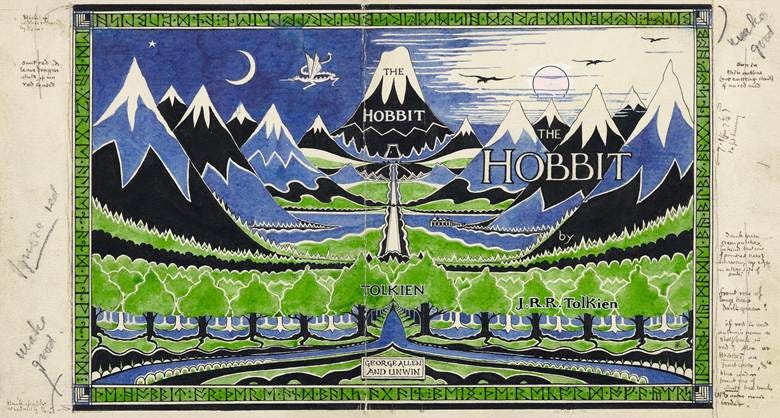
Before the story begins, we are greeted by the cover. There are many different covers to The Hobbit now, but when it was first publish, Tolkien’s own design was on the dustjacket (pictured below). What did Tolkien, as author and illustrator, choose for the border, the literal frame, of the picture? A continuous line of dwarvish runes. Starting at the bottom left corner, they translate to “The Hobbit or There and Back Again, being the record of a year’s journey made by Bilbo Baggins; compiled from his memoirs by J.R.R. Tolkien and published by George Allen & Unwin…”
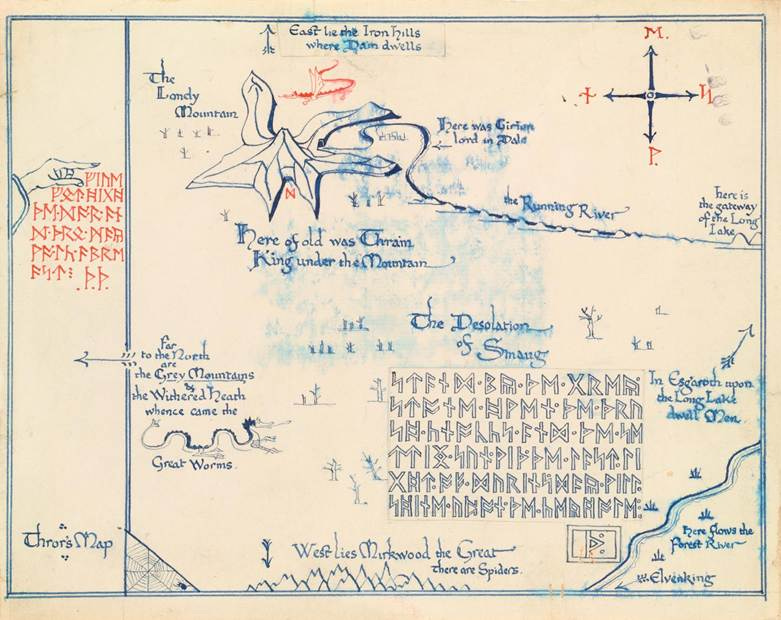
Okay, we might think, so what? It adds visual interest and a foreign flare. Big deal. Yes, but it doesn’t stop there. Open the cover and you are met by two pieces of front matter that are easy to ignore or skip. One is Thror’s Map, composed of as much language as it is pictures and symbols, and language that is as much runic as it is English. Indeed, I think the language dominates the map, not just because of the ink color (the moon runes are in red, matching the color of the dragon and location of the hidden door, among other things) but in size. The rectangles of runes are as large as symbol of The Lonely Mountain which is the largest geographic symbol on the map. The scripts are also beautifully drawn which gives them added interest and emphasis.
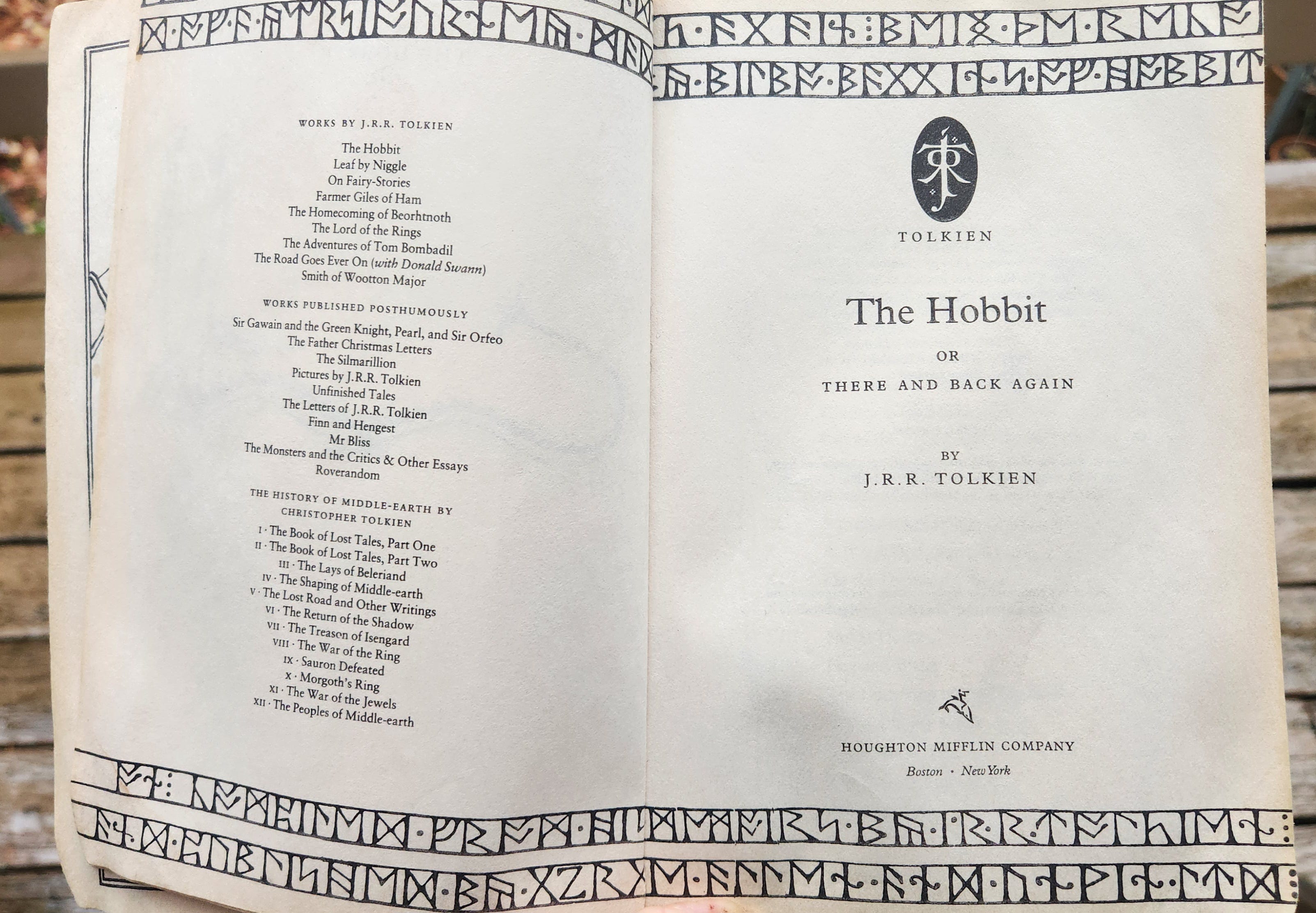
Next, the title page, with iny version (pictured below)has a top and bottom margin of runic ribbon, again literally (in both senses of the word) framing the page, followed by the table of contents and then, depending on your edition, a note on the text by Douglas Anderson.
Finally, just before chapter one begins, we have Tolkien’s own note on the text written by a translator introducing a work of translation. This note is titled in runic letters which translates to, “The Hobbit, or, There and Back Again.” The reader is again confronted with a foreign language and, very importantly, Tolkien here gives the reader the means to translate it. The reader is invited to participate in the translation. In this note, Tolkien also addresses the reader as though a linguistic scholar (or philologist in T’s case) was prefacing a work of translation for his peers. He provides a brief explanation of linguistic anomalies and translation difficulties as well as any history or similar information that the reader might need to make sense of what follows. I own a book of Old English poetry translations which have similar introductions to each poem. Tolkien, as an actual translator, brings that tone of scholarly translation to his work of fiction.
Sobefore we ever read that wonderful opening line, “In a hole in the ground there lived a hobbit,” we the readers have been thrice confronted with dwarvish runes in some form or other. It is this visual frame of unknown language – which Tolkien gives us the key to translate – that sets The Hobbit apart as not only a wonderful story but a story of layered linguistic interest. We are visually queued to notice the language.
Language as fulcrum
Full disclosure – I had to look up “fulcrum” to make sure my layman’s understanding of it was accurate. This article helped and it is from which I quote the following definition:
“A fulcrum is a fundamental component in mechanical systems, enabling the conversion of forces into motion or vice versa. It serves as a pivot point around which a lever or a beam can rotate, allowing for the transmission of forces from one end to another.”
Language is the fundamental component in this story system, not only as a vehicle to communicate the story but as a point within the story on which the plot nearly always pivots. From almost the first paragraph, the playful ambiguity of language is brought to center stage in The Hobbit and this ambiguity of language becomes a kind of philological setting for the story. Language is hardly ever mentioned per se,5 but the whole story is surrounded by it and balances on it from beginning to end. Again, not only as vehicle of the story itself but as the cogs and wheels of the plot points within it. What is said is not necessarily what was meant, and what was meant is not necessarily what was said.
Though I’ve read The Hobbit at least a dozen times, I hadn’t consciously noticed that it is an almost continual comedy of errors and that these errors are the points on which each adventure pivots and is resolved. I also hadn't notice that each crucial turn of the plot hinges on language, usually language taken more literally than the speaker intended. Almost everything that is said by the characters in The Hobbit could be tagged with a quote Benedick from Much Ado about Nothing: “There’s a double meaning in that.”
(there might be some spoilers ahead, just fyi)
In the first line of the first chapter, we are told, “In a hole in the ground there lived a hobbit.” I think we are meant to be immediately asking, “A who in a what?? Did he mean a rabbit?” (‘Rabbit’ and ‘Hobbit’ are continually paired through the story.6) Indeed, this question of “What is a hobbit?” is asked by everyone about Bilbo throughout the book and though Tolkien tells us, the characters in The Hobbit are never given any kind of firm answer. He is unfamiliar to readers because we no longer live in the time where we could pass through Hobbiton and have a half-pint at the Green Dragon, let alone come upon them unawares. But he is also unknown to everyone (the Rivendell Elves excepted) in the Wide World in his own time. In Celtic fairy tales, you often have a visitor from the Otherworld calling someone in our world to come to the Otherworld, and when he goes he usually finds the Otherworld strange and perilous. In The Hobbit, Bilbo is called to the Otherworld by Gandalf, but when he gets there, the land of Faerie is as much puzzled by this small relative of modern man finding his way into their world as he is by them. Maybe more. Bilbo has at least a rudimentary knowledge of stories and the workings of dwarves and things of that sort. But no one in the Wilderland seems to know exactly what to make of him. They can’t place his smell or his appearance. His unfamiliarity becomes a shield, a sort of cloak of invisibility, or more precisely, of misdirection.
To return to the explanatory beginning of The Hobbit – Tolkien as translator of Bilbo’s Red Book of Westmarch must break in during his introduction to tell us exactly what a hobbit is, and once we have that straight he goes on to plunge us into a consideration of the many meanings of the very banal phrase, “Good morning!” Bilbo mechanically trots out the greeting to someone he thinks is just a wandering old man, and Gandalf the wizard immediately responds by asking, “What do you mean by ‘Good morning’?” and then goes on to list four possible meanings, with which Bilbo wisely agrees (it’s best to be agreeable when it comes to wizards - see Roverandom for further proof - though Bilbo doesn’t know it’s a wizard he’s speaking with yet; lucky that Bilbo was polite) and adds his own meaning into the bargain. This almost-double beginning - one directed to us as the reader who needs to be caught up and informed, and one in the usual manner of “Once upon a time” – centers on language’s opacity and meaning’s elusiveness even (or maybe, especially) in the most well-known greetings. It simultaneously introduces the sense of nuance and ambiguity in both an unfamiliar word and a commonplace phrase.
We see this happen again in the first adventure with the trolls; Bilbo calls himself “a bur - a Hobbit,” cutting off “burglar” when he realizes he is saying too much and substituting it with the word “hobbit” which no one seems to know. But the trolls hear one single word - burahobbit. They have no idea what this is, of course, because, as we know, it is nothing. There is no such thing. Bilbo has become the accidental riddle-maker, a role he will take on intentionally later in the story. And the trolls have become victim of metanalysis.7 When the trolls ask Bilbo if there are any more like him, he answers “Lots!” thinking of himself as one of the company, and then, when he again realizes he shouldn’t have said so much, he says, “No! None at all!” As the trolls point out, both statements are true (lots of companions, none like Bilbo), though Bilbo did not realize it or even mean it that way when he said it. Language came to the rescue without the speaker’s intention. It worked it’s own riddling magic on the trolls, delaying their mischief until Gandalf comes back to rescue them properly.
As I said, in each adventure the plot pivots on language meant vs language understood. But I want to focus on two examples which were new to me this time because of the way they connected with each other. The first is from chapter five, the very end of the riddle game.
Bilbo is out of riddles. He can think of nothing to ask Gollum.
“Gollum was disappointed once more; and now he was getting angry, and also tired of the game. It had made him very hungry indeed. This time he did not go back to the boat. He sat down in the dark by Bilbo. That made the hobbit most dreadfully uncomfortable and scattered his wits.
‘It’s got to ask us a question, my precious, yes, yess, yesss. Just one more question to guess, yes, yess,’ said Gollum.” (emphasis mine)
What Gollum meant was Bilbo must ask Gollum another riddle. But that is not what he said. He told Bilbo to ask him a question and Bilbo, out of sheer luck and without really thinking about what he is saying, asks Gollum the one question he would never have gotten right (technically Bilbo is actually asking himself a question but lucky for him, he absentmindedly says it aloud).
It’s not a huge literary observation, but it is interesting to me that it is this intended meaning vs literal meaning that saves Bilbo, not a clever riddle or any kind of physical prowess. It's not even asked intentionally. In the Prologue to The Lord of the Rings, we are told that “the Authorities, it is true, differ whether this last question was a mere ‘question’ and not a ‘riddle’ according to the strict rules of the Game; but all agree that, after accepting it and trying to guess the answer, Gollum was bound to the promise.” One might consider making the argument to these Authorities that Gollum was actually the one to change the game when he told Bilbo to ask him a question. Bilbo merely does as Gollum asks.
The second example of the plot pivoting on language in a similar way is when Thorin tells Bilbo, “As for your share [of the treasure]…you shall choose your own fourteenth…” Tolkien draws our attention back to this rash vow of Thorin’s in chapter XVII. Thorin’s Arkenstone was claimed by Bilbo before Thorin had claimed it for himself. Bilbo had chosen his share of the treasure, and later tells an angry Thorin, “You may remember saying that I might choose my own fourteenth share? Perhaps I took it too literally.”
This is not a revelation. Tolkien himself draws our attention to Thorin’s language in Bilbo’s response in chapter 17. But it was new to me to see that both Gollum and Thorin meant something more nuanced than the literal meaning of their statement - they meant something perhaps unconcious to even themselves - and that Bilbo’s focus on this nuanced meaning is what saves him from danger as well as outright cheating or stealing from Gollum and Thorin. (He remains “an honest burglar” though both Gollum and Thorin call him a thief.) It also saves both Gollum and Thorin from their own desires, though Gollum never appreciates it and Thorin only too late.
Something else interesting to note; we see in both of their examples how words in Tolkien’s world can lay a kind of claim on the speaker, though the speaker might be held unawares. Gollum promises to lead Bilbo to the goblin tunnel exit if Bilbo wins. Thorin promises Bilbo his own choice of the treasure. Both are held to their word in ways they do not expect. This gives language a weight and authority in The Hobbit (and in all of Tolkien’s other works) that it doesn’t not seem to have in our real lives. Though here again, words from Shakespeare come to mind: ‘“Seems,” madam? Nay, it is; I know not “seems.”’8
Riddles and charms, plays on words, double meanings, equivocations and assumptions are everywhere in The Hobbit. Literally (ha) everywhere. If The Hobbit were a sponge and you wrung it out, words-at-play would drip from it. These each and all center on the funny way language can seem to have a mind of its own, how it can obfuscate rather than make clear or the way a single phrase can mean two (or four - or more!) different things to different people. No surprise considering Tolkien was a philologist, a dictionary-ist (he worked on the OED), a maker of private languages and an appreciator of pranks and jokes himself. Tolkien knew that children of all ages love word play.
We are designed for speech, we express ourselves through language, but Tolkien playfully shows that it’s more often a tricky business than not trying to make yourself understood, and it’s best to be aware, whether in the the Everyday World or the Otherworld, that you mean what you say and say, or try to say, exactly what you mean.
I just finished teaching The Hobbit in my Junior High Literature class at our co-op, which means I now have a couple of essays about The Hobbit in my Substack drafts folder.
Nothing I’m writing in these three articles will be new. I am not contributing to the growing body of Tolkien scholarship, though it is a dream of mine. (Maybe when I grow up. Maybe in heaven.) Though these were new observations for me, or deeper connections of past observations, I am positive other Tolkien fans have seen these things and written about them better and at a greater depth than I have or am able to. I just haven’t read those papers. And maybe you haven’t stumbled on those writings, either. Maybe this is the first time someone is taking you in for a closer look at the fine, detailed craftsmanship in Tolkien’s work. Hopefully these essays encourage you to go back and read The Hobbit with one eye on the story and the other on Tolkien’s marvelously deft, winking way of telling a really good story of unexpected emotion and depth. If you do decide to go deeper with real Tolkien scholarship, Drs. Michael Drout, Tom Shippey, and Verlyn Flieger are all great scholars to start with, each worth their weight in ink and paper. They all have talks and interviews available on YouTube and articles floating around the internet.
“He could laugh at anybody, but most of all at himself, and his complete lack of any sense of dignity could and often did make him behave like a riotous schoolboy. At a New Year’s Eve party in the nineteen-thirties he would don an Icelandic sheepskin hearthrug and paint his face white to impersonate a polar bear, or he would dress up as an Anglo-Saxon warrior complete with axe and chase an astonished neighbour down the road. Later in life he delighted to offer inattentive shopkeepers his false teeth among a handful of change. “I have,” he once wrote, “a very simple sense of humour, which even my appreciative critics find tiresome.”
From J.R.R. Tolkien, A Biography by Humphrey Carpenter
letter 131 to Milton Waldman
available on Audible, Everand, Libby, Hoopla, and Archive
except in one instance which Tolkien calls attention to in a letter to Auden: “The only philological remark (I think) in The Hobbit is on p. 221…an odd mythological way of referring to linguistic philosophy, and a point that will (happily) be missed by any who have not read Barfield…” Here is the section Tolkien refers to:
To say that Bilbo’s breath was taken away is no description at all. There are no words left to express his staggerment, since Men changed the language that they learned of elves in the days when all the world was wonderful.
The Hobbit, chapter 12
Tom Shippey gives several possibilities as to why in Author of the Century p.4-5 and p. 45-46, and I have a theory I’m mulling over which is connected with rabbits drawn in medieval manuscript
From Merrium-Webster:
metanalysis
noun
met·anal·y·sis ˌme-tə-ˈna-lə-səs
: a reanalysis of the division between sounds or words resulting in different constituents (as in the development of “an apron” from “a napron”)
Hamlet (1.2.77)
When you're first apprenticing yourself to writing, it starts with ideas and almost always you've got to let go of the first idea or to deepen it. So I think real writing comes from actually getting below the horizon of the place where you mediate things through language. So in other words, you go to the unspoken. You tend to think, when you're a young poet, that you're going to go inside and eventually find this place from which you'll know exactly what to say. But my experience is it's almost the exact opposite. You're going to go to the place inside you that doesn't know what to say, and that's the place that's going to speak. And that's what's miraculous. - David Whyte